The Hempstead Plains: An Ancient New York Grassland
This whole tract appears as smooth and unbroken as the surface of the sea in a calm, though as you pass over it, you meet with slight undulations, and the views of the traveler over the whole expanse is unobstructed, by tree, or shrub, or any other vegetable production. Within the memory of persons still living, there was scarcely an enclosure in this whole compass….
–Nathaniel Prime, 1845
Imagine a prairie in the middle of Long Island! A sea of grass where the sod was so thick early farmers could not cut it, and where they turned their cattle out to graze on its fine grasses and raced their horses across its unbroken expanse. Formed thousands of years ago, this was the most ancient of New York grasslands.
Hempstead Plains was once the only extensive prairie east of the Alleghenies. It’s estimated the prairie covered around 40,000 acres, perhaps more; today, only a fraction remain. The 19-acre Hempstead Plains Preserve is the largest remaining parcel of original New York grasslands; an additional parcel will be restored at a 66-acre preserve that when fully restored will include a grassland habitat among other native habitats. These parcels have been saved from development and are being restored thank to the assiduous and persistent efforts of the Friends of Hempstead Plains.
Hempstead Plains Preserve
Little Bluestem (Schizachyrium scoparium)
How the Prairie Evolved
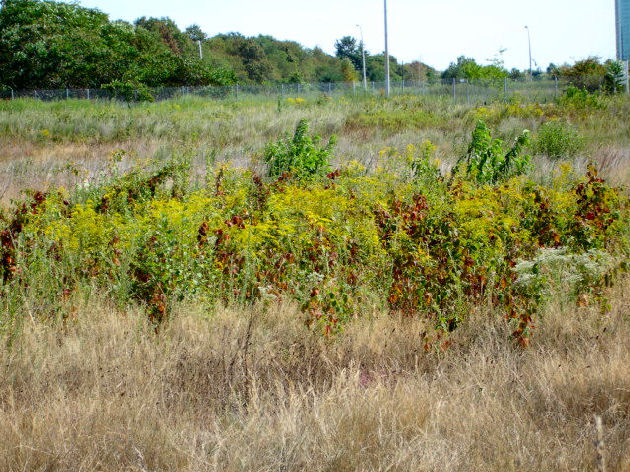
Long Island’s ancient prairie established itself on glacial outwash after the last glacier receded. It was a climax ecosystem—one that had evolved over the millennia to reach its grassland state, which if left undisturbed would have remained a prairie forever. It may once have been part of a continuous band of sand-prairie grassland that extended from New Jersey to Massachusetts. Like the Midwestern prairies, it was a tallgrass prairie, dominated by big bluestem (Andropogon gerardii), little bluestem (Schizachyrium scoparium), Indian or nut grass (Sorghastrum nutans), and switchgrass (Panicum virgatum).
Growing among these prairie grasses were wildflowers, including Wild Indigo (Baptisia tinctoria), Canada Cinquefoil (Potentilla canadensis), Gray Goldenrod (Solidago nemoralis), Early Goldenrod (Solidago juncea), Butterfly-weed (Asclepias tuberosa), Stargrass (Hypoxis hirsuta), Fringed Violet (Viola sagittata), Bird’s-foot Violet (V. pedata), Flax-leaved Stiff-Aster (Ionactis linariifolia), Hyssop-leaved Boneset (Eupatorium hyssopifolium), and Northern Dewberry (Rubus flagellaris). These native plants are still present today in what remains of the prairie despite its degraded and fragmentary state.
Stargrass (Hypoxis hirsuta)
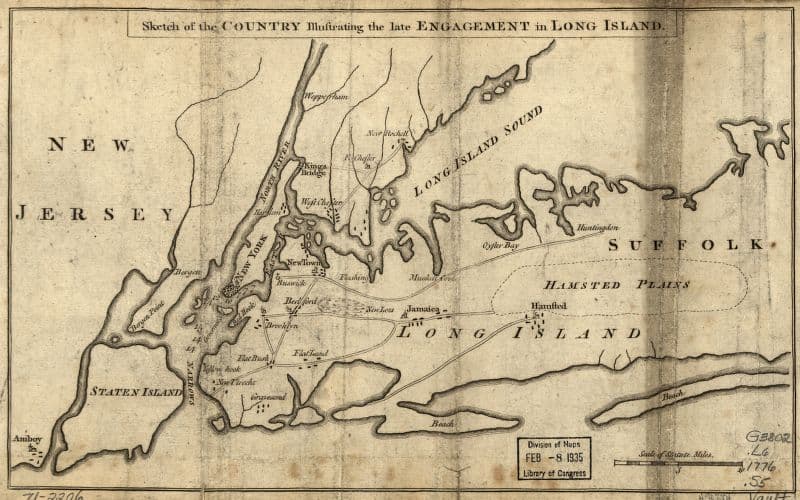
British map of Long Island showing Hempstead Plains, 1776, Library of Congress [Public Domain]
How the Prairie Was Degraded
Colonization: from Common Lands to Subdivisions
The first Europeans to colonize the prairie were a group of English Dissenters led by Reverend Richard Denton, who purchased the “Great Plains” in 1643. Daniel Denton, son of Richard, described the plains: “Toward the middle of Long Island lyeth a plain, sixteen miles long and four broad, upon which the plain grows very fine grass that makes excellent good hay, and is very good pasture for sheep and other cattle, where you shall find neither stick nor stone to hinder horses’ heels or endanger them in their races.”
The Plains was eventually subdivided among different families and fenced, leaving 17,000 acres as common land well into the nineteenth century. These common lands were used for cattle grazing and as seasonal hunting grounds by game bird hunters. Later, the open lands came to be used as military bases and with the rise of aviation, as air fields, hence the region’s name, “Cradle of Aviation in America.” Ironically, its maintenance as an airfield helped preserve a portion of this ancient New York grassland.
Garden City development, 1895, lithographer Robert A. Welcke, New York Public Library Digital Collections [Public Domain].
Levittown, New York, houses circa 1958. Courtesy Library of Congress, Prints and Photographs Division (Public Domain)
Suburbanization: Housing Tracts and Shopping Malls
Suburbanization encroached on the Plains as early as 1869, when department store magnate Alexander T. Stewart purchased a 7,500-acre tract to develop the first planned suburb in New York City, which he called Garden City. It was intended as a working-class suburb for renters, most of whom were his own employees, but the project failed for lack of takers. Garden City continued to be developed as a suburb for homeowners. Small developments slowly parceled out this ancient New York grassland, consuming twenty percent by the early 1900s, although thousands of acres still remained untouched. It was not until the postwar baby boom following World War II that suburban developments spread like wildfire across the former prairie, eventually reducing it to one percent of its original expanse.
In 1946, William Levitt bought and subdivided the old estate of Alexander Stewart and subdivided it into 17,000 lots. What came to be called Levittown became the model for the cheaply built tract-style suburbs that would cover the middle of Long Island. Levitt’s working-class suburb was spectacularly successful, providing affordable housing to working-class owners, many of whom worked in the aviation industries that once flourished on Long Island. By 1960, 17,000 houses had been completed. 17,000 houses in this development alone meant 17,000 lawns, which introduced alien grasses and other invasive flora that out-competed native species. Suburbanization brought shopping malls: Roosevelt Field, once the largest civilian airfield in America, became one of the oldest shopping malls in America, paving over 360 acres of former grassland with concrete.
Pearl Crescent butterfly in butterfly weed
How the Prairie is being Restored
It represents one of the most rapidly vanishing habitats in the world, along with scores of birds, butterflies, and other animals that are vanishing with it.
–Friends of the Hempstead Plains
Professor Betsy Gulotta of Nassau Community College was instrumental in saving the last patches of this ancient New York grassland. The Hempstead Plains Preserve was established on a parcel of land on the Nassau Community College tract. The Friends of Hempstead Plains organized themselves in 2001 under Gulotta’s leadership, and have worked tirelessly to protect their bit of prairie and restore it to its original state. That has meant assiduous efforts in rooting and burning out non-native and invasive plants, and re-seeding or planting species native to the original prairie. They have protected the preserve from dumping and trashing, and attempted to guide development along its fringes to be compatible with the preserve. They have also reached out to the community and promoted good stewardship, building an environmental education center to teach a new generation about the value of preserving endangered native ecosystems like prairies. Partnering with The Nature Conservancy and the New York State Department of Environmental Conservation, the Friends of the Hempstead Plains saved 19 acres of the former prairie, and they are gradually increasing the acreage into a new preserve site. These prairie fragments are now considered a Natural Heritage Site because the prairie is considered a “globally rare community.”
Bird’s Foot Violet (Viola pedata)
New England Blazing Star (Liatris scariosa)
Threatened Flora of New York Grasslands
Not only are New York grasslands like the Hempstead Prairie increasingly rare, but several New York grassland plants are rare and imperiled as well. One example is the lovely Bird’s foot Violet (Viola pedata), which once stained the grasslands of Long Island purple every spring. Though not restricted to grasslands, it’s considered imperiled in New York State.
In the Sayville Grassland on Long Island, a 127-acre parcel of coastal grassland managed by the U.S Fish and Wildlife Service (not open to the public), at least 10 species of rare and/or threatened native plants flower. These include Northern Blazing-Star (Liatris scariosa var. novae angliae) and Sandplain Gerardia (Agalinis decemloba) (originally Agalinis acuta). Liatris scariosa, also known as Liatris borealis, is a threatened wildflower in New York State restricted to Long Island and Dutchess County in the Hudson Valley. It can be grown from seed in native plant gardens. Sandplain Gerardia, in contrast, cannot be cultivated. It depends on an intact coastal plains grassland, which has vastly been reduced in range. To see more photos of New York grassland wildflowers, visit my New York Wildflowers Gallery page.
Sandplain Gerardia (Agalinis decemloba)
The delicate Sandplain Gerardia is a true grassland plant, depending on the presence of Little Bluestem, whose roots are thought to provide nutrients and moisture in a hemi-parasitic relationship. In 1988, Sandplain Gerardia was placed on the federal list of endangered species. Marilyn Jordan of the Nature Conservancy was instrumental in the effort to conserve this little flower, beginning in 1992. In a report she wrote for the US Fish and Wildlife Service in 2003, she stated that once vast coastal grasslands of the Northeast (estimated to have been 60,000 acres) had been reduced to a mere 200 acres. Without intact coastal grassland, the Sandplain Gerardia cannot survive. Long Island has the most viable remnant populations, with the largest number at the Sayville Grassland. With protection, the wildflower rebounded from a mere 500 in 1990 to 80,000 in 2003, when she wrote her report. She emphasized that preserving grassland habitat through periodic mowing and prescribed burns had been critical to the flower’s success. However, since she wrote her report in 2003, the population crashed again in 2005, down to about 10,500. Because its seeds remain viable for only four years, a prolonged drought can devastate a whole colony, which has occurred several times since 2003. A drought in 2012, for instance, devastated the wildflower. It continues to be listed as Endangered.
Threatened Birds of New York Grasslands
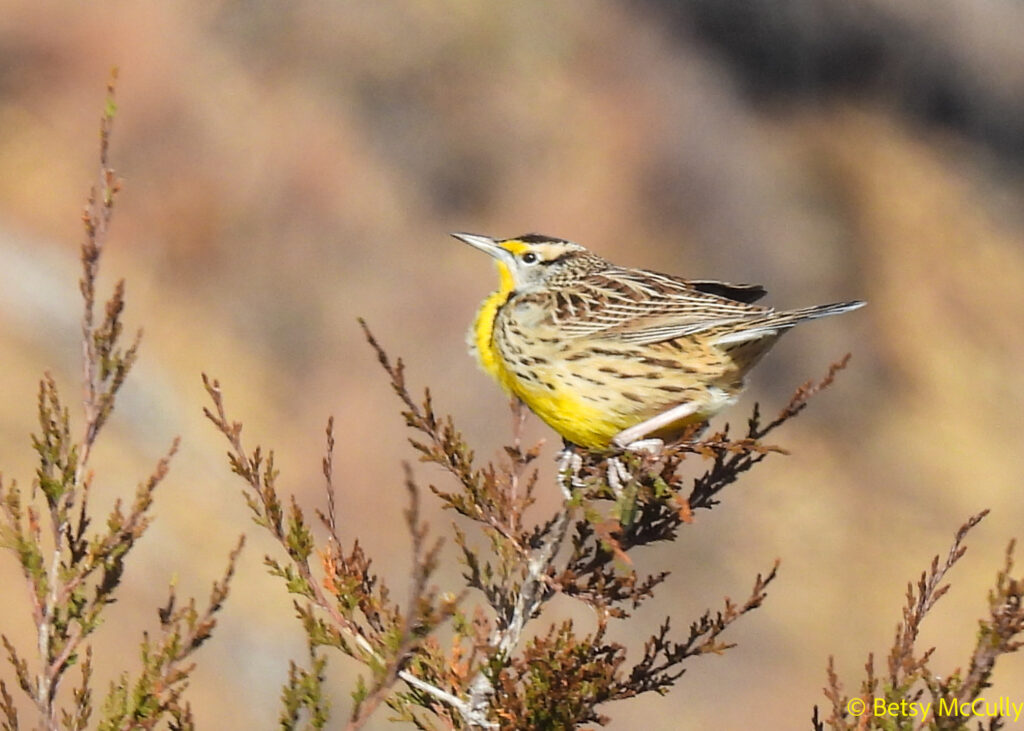
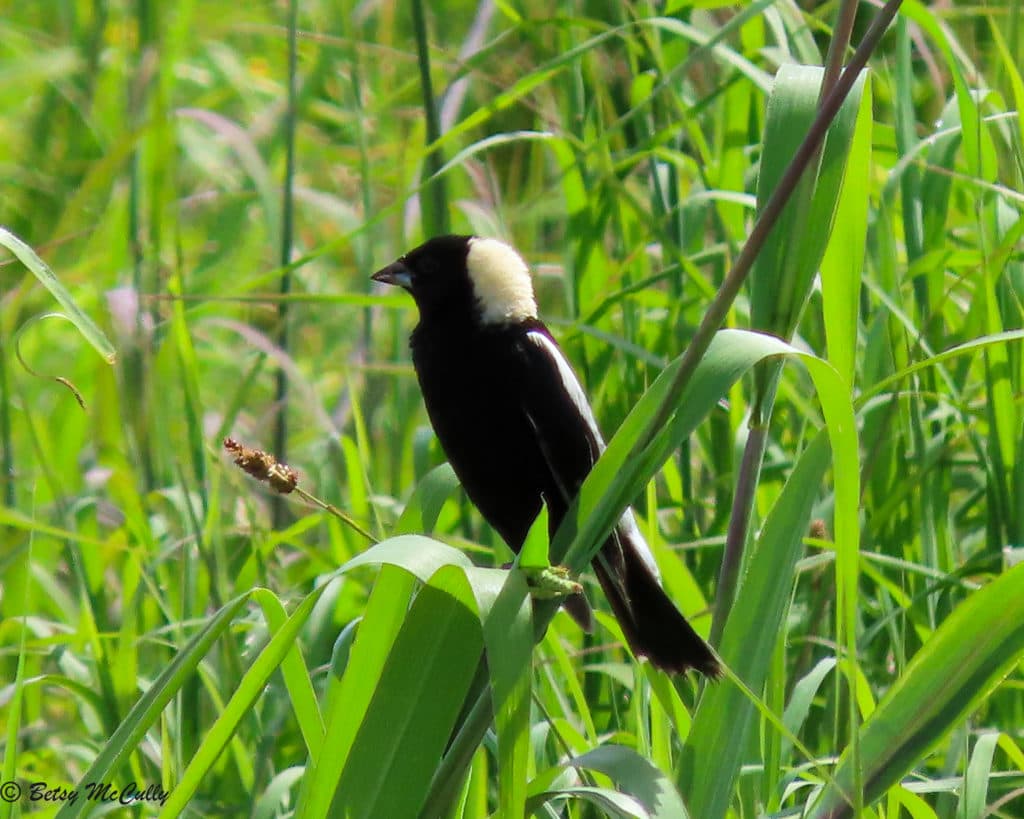
Diverse species of birds also depend on grasslands to nest. These include Savannah Sparrow (Passerculus sandwichensis), Grasshopper Sparrow (Ammodramus savannarum), Bobolink (Dolichonyx oryzivorus), and Meadowlark (Sturnella magna). They will disappear from a region if their breeding habitat disappears, but may return if that habitat is restored — or so it is hoped. Calverton Grassland, 800 acres located on an abandoned airfield on Long Island, is another example of a recovering grassland — but it, too, is vulnerable to encroaching development. At least a core may be preserved because it lies within the Pine Barrens atop the Magothy Aquifer, the main source of Long Island’s fresh water. It was here that I encountered breeding Grasshopper Sparrows, a once common grassland bird that has been in steep decline. To see more photos of grassland birds, visit my New York Birds Gallery page.
Savannah Sparrow (Passerculus sandwichensis)
Eastern Meadowlark (Sturnella magna)
Bobolink (Dolichonyx oryzivorus)
How Can We Preserve New York Grasslands?
What Farmers Can Do
The Massachusetts Audubon Society published a detailed set of recommendations for farmers to follow who wish to preserve grasslands on their property (click here to download a pdf of their publication, “Best Management Practices for Grassland Birds,” 2017, 12 pages). While recognizing the economic incentive of hay mowing, as well as the necessity of mowing to maintain grassland, the Society urges farmers to leave undisturbed a minimum of 10 acres or, ideally, 60-100 acres, or to at least avoid mowing just before and during breeding season.
What Town Planners Can Do
Suburbanization, from housing developments to malls, erase grassland habitats — and once erased they can never be recovered. If we are to preserve what’s left of these vital endangered habitats, town planners can limit the scope and siting of such developments and set aside grassland preserves.
What Homeowners Can Do
Consider replacing your chemically dependent and water-hogging turf lawns with native grasses, sedges, and wildflowers. You will not only be removing harmful chemicals from the environment and conserving water, but you will be supporting our native birds and pollinators as well as restoring grassland habitats. There are local organizations that can support your yard transition from a conventional lawn to a healthy and diverse native habitat. These include Rewild Long Island and Long Island Native Plant Initiative. For more detailed information on native flora, see the New York Wild Flora page on this website.
Not a Homeowner? You Can Become a Land Steward!
New York City Parks has a stewardship program you can join to do your part in restoring and maintaining native habitats, including grasslands. You can also volunteer with a local conservation group.
Grasshopper Sparrow (Ammodramus savannarum)
Calverton Grassland, Long Island
New York Grasslands Reading List
McCully, Betsy. City at the Water’s Edge: A Natural History of New York (Rutgers University Press, 2007)
McCully, Betsy. Land at the Glacier’s Edge: A Natural History of Long Island from the Narrows to Montauk Point (Rutgers University Press, 2024)