Alley Pond Park trees and kettle pond, Queens, New York, by Betsy McCully
We see permanence in the hills we get to know. They do not visibly change, but we can grow up with trees and see them change with us. Since they can outlive us, they connect us to the future and to the places where they grow.
–Berndt Heinrich, The Trees in My Forest, 1997
For at least 5,000 years prior to European settlement, it’s estimated that 95% of the Northeastern United States (the Northeast) was covered by forest. A mere 1.5 million acres remain of an original 822 million acres, according to a survey conducted by Mary Byrd Davis in 1993. The thickest forests were north of New York City; our region was a patchwork of forests, wetlands, grasslands, and sand plains, a land long managed by the village-agriculturalists who lived in the region, the Lenape Indians. (For the story of the first New Yorkers, see the page The Lenape.)
How New York Forests Evolved
Rutherford Platt, in The Great American Forest (1965) tells us that our deciduous forests evolved nearly 50 million years ago and continued to evolve through successive climate change eras. The last ice age modernized our forest, as new species were added to existing families. In our region, after the last glacier receded, tundra gave way to a patchwork of tundra, bog, and spruce swamps, thence to jack pine forests, which migrated northward as a mixed forest of pines and hardwoods moved in.
A hallmark of modern hardwood forests is an understory of flowering trees and shrubs, including sassafras, viburnum, amelanchier, magnolia, laurel. All these species were present here in the Late Cretaceous some 65 million years ago, as we know from fossils found in Cretaceous rocks on Long Island and in New Jersey. Hollies are the most ancient of our species, originating nearly 90 million years ago, disappearing at one point, then reappearing in our post-glacial era.
Mountain Laurel
Red Cedar
New York Forests Today
Today, our woodlands include maritime woodlands, such as holly, beech, oak, and red cedar; coastal oak-pine, oak-hickory, oak-beech, and oak-laurel forests of uplands, such as morainal slopes and ridges; red maple-tupelo and white cedar swamps of lowlands; oak-tulip tree forests of highlands, such as on morainal ridges of northern Long Island; and pitch pine-oak of outwash plains. The trees that dominate our deciduous woodlands are oaks and hickories; the chestnut was originally one of the dominant trees but these were killed by a devastating blight that hit in the early twentieth century.
Dwarf Pitch Pine
One of the most unique forests in the world is the Pine Barrens of central Long Island. The Barrens is characterized by the pitch pine (Pinus rigida), a rugged tree that can thrive in poor, sandy soil and survive temperatures of up to 2000 degrees fahrenheit. This forest took root in the gravelly outwash of the post-glacial landscape, and over the millennia was maintained by periodic natural fires; in fact pitch pine cones depend on fire to open them and release their seeds.
“Commercial Beginning of NY”, 1854, Carl Emil Doepler, artist; Lossing and Barritt, engravers, from the New York Public Library Digital Collections [Public Domain]
How New York Forests Became Degraded
The Impact of Colonization on Forests
Thus the inhabitants are very busy here, not only to lessen the number of trees, but even to extirpate them entirely. They are here and in many other places in regard to wood, bent only on their present advantage, utterly regardless of posterity. By this means many cedar swamps are already quite destitute of cedars….
—Peter Kalm, Travels in North America, 1750
When Europeans colonized the region, they quickly depleted the old-growth forests. Shipbuilding, in particular, required steady supplies of timber; a single warship, for example, consumed 2,000 old oak trees. Old-growth pines were cut to supply ship masts. Atlantic white cedar swamps were quickly depleted of trees, which were felled for their rot-resistant wood to shingle houses. In the mid-1700s, Swedish naturalist Pehr Kalm noted the colonists’ wasteful and careless methods of clear-cutting cedars and other trees in the New York region: “Thus the inhabitants are very busy here, not only to lessen the number of trees, but even to extirpate them entirely. They are here [New Jersey] and in many other places in regard to wood, bent only on their present advantage, utterly regardless of posterity, By this means many cedar swamps are already quite destitute of cedars….”
Colonial farmers cut down trees with wasteful abandon, clear-cutting to create cropland and pasture. Domestic animals like cows and pigs trampled the understory and compacted the soil, which reduced the soil’s water-retaining capacity and prevented saplings from growing to maturity. Between 1700 and 1900, 75% of New York State was deforested.
The Impact of Industrialization on Forests
Much of the Hudson Valley was clear-cut every thirty or forty years….
–Robert Boyle, The Hudson River: A Natural and Unnatural History, 1970
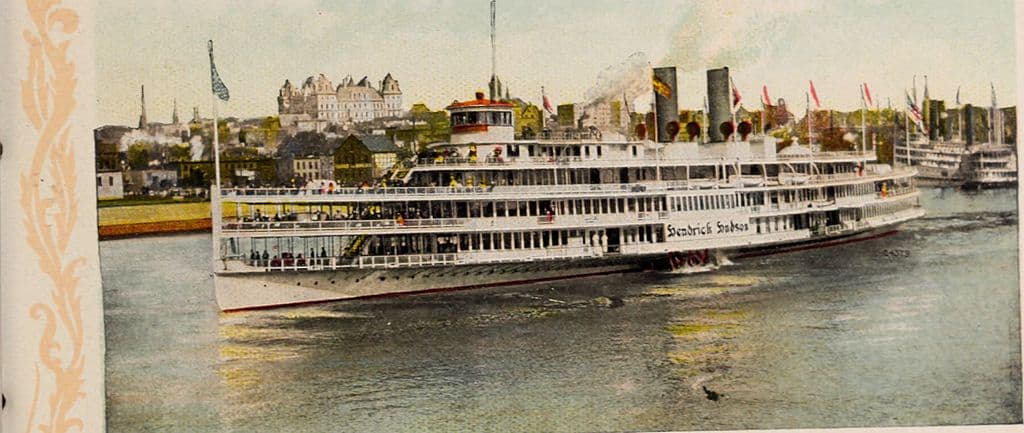
Industrialization in the nineteenth century stepped up the rate of destruction. The iron industry was particularly fuel-intensive, writes Robert Boyle in his history of the Hudson, and as a result, “much of the Hudson Valley was clear-cut every thirty or forty years.” Before coal came into common use as a fuel, wood was burned to power factories, steamboats and steam trains. On the Hudson alone, Boyle writes, “as early as 1825, the thirteen steamers on the Hudson and the ferries in the harbor used one hundred thousand cords of wood in the eight months of the year the river was free of ice. Wood was cut on the top of the Palisades and slid down the cliffs to deep water. Thus the name High Gutter Point on the New York-New Jersey state line.”
Hudson River steamers, “Souvenir Views of the Hudson,” 1909, postcard image via Wikimedia Commons [Public Domain]
In traveling these forests,… you may pass through 5, 6, and even 7 miles of unbroken forest, without discerning a single human habitation, or the least trace of the hand of man except the stumps of felled trees….
–Nathaniel Prime, 1840
In the Pine Barrens, pitch pine trees were tapped to extract their valuable sap, which was processed into turpentine and pitch (hence their name). Tapping entailed making cuts a foot above the base of the tree, which eventually killed the tree. The Barrens were also clear-cut to provide both timber and fuel wood, as were the upland oak-hickory forests of Long Island. Reverend Nathaniel Prime, when touring Long Island to make a report on its churches in the 1840s, described passing through “5, 6, and even 7 miles of unbroken forest, without discerning a single human habitation, or the least trace of the hand of man except the stumps of felled trees.” Despite the clear-cutting, Prime found that Long Island still had more forested lands than he found in the Hudson Valley, where he had lived.
Pitch Pine bark and leaves
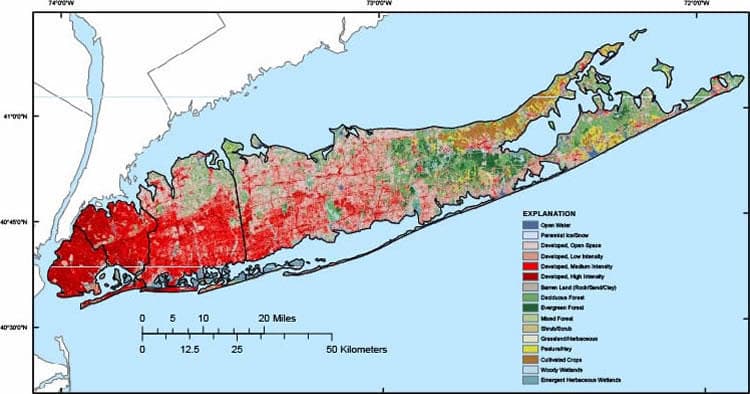
Long Island Land Use Map, 2006, USGS [Public Domain]. The green area is the preserved Pine Barrens.
How New York Forests Continue to be Degraded
Suburbanization, particularly since the 1960s, has continually eroded forest lands. The Long Island Pine Barrens once encompassed 250,000 acres and is now reduced to a core protected area of around 52,000 acres, with a so-called “Compatible Growth Area” of about 48,000 acres where planned development is allowed. The Barrens would have been more severely eroded if not erased were it not for robust preservation efforts by the Long Island Pine Barrens Society aimed at protecting the most vital source of fresh water on Long Island, the Magothy Aquifer that lies beneath.
Added to the stresses of development, a new threat endangers the ancient pine barrens. The Southern Pine Beetle has spread from the southern states to our region and is rapidly killing whole stands of pines, culling thousands and thousands of acres. They have spread here as our winters have become warmer. Once here, they are impossible to eradicate, so foresters can only try to control their spread.
Southern Pine Beetle credit: NYS DEC
Another threat to our forests is posed by White-tailed Deer, whose populations have exploded in recent decades. Deer are radically changing the composition of our forests by consuming the understory. Blueberries and other berry-laden heaths, native wildflowers like orchids, and tree saplings have been nipped to the ground. Woods have been taken over by catbrier and weeds are invading niches emptied of native wildflowers.
Luna Moth
Besides their impact on native woodland flora, deer are destroying the protective understory that provides cover and food for birds, butterflies and moths. Both bird and insect populations that depend on healthy, diverse woodlands, are declining, and in woodlands severely denuded by deer, disappearing altogether. A 2005 report by the New Jersey Audubon Society stated that 14 woodland bird species and some 30 species of native wildflowers had disappeared from forest sanctuaries overrun by deer.
Pink Ladyslipper
The woodland wildflowers that are disappearing include wood anemone, trillium, dwarf ginseng, trout lily, and orchids such as ladyslippers; birds include towhees, thrushes, black-and-white warblers, pine warblers, redstarts, and scarlet tanagers. Loss of biodiversity, from trees and shrubs to birds and insects, will be the fate of forests if deer populations are not controlled and reduced.
Scarlet Tanager male
Conservation ecologist Emile De Vito published an opinion piece in the New York Times in 2008 warning about the “catastrophic impact” of deer on tree regeneration and forest biodiversity in the New York metropolitan region: “Our native forests and associated biodiversity will melt away, as can already be seen in many places, if we continue to ignore these threats.”Where their numbers have been reduced, and understories allowed to grow back, trees and shrubs are regenerating and birds and wildflowers are returning. To see more photos of our woodland wildflowers and birds, visit my New York Wildflower Gallery and New York Bird Gallery pages.
Northern Parula (Setophaga americana), June 2023, Montauk (Hither Woods). Breeder.
How New York Forests are being Restored
Old-growth native forests in the New York region are precious few. None date to before the Revolution since British troops cut down all the trees for fuel. Remnant forests include the Midwood section of Prospect Park in Brooklyn, a section in the New York Botanical Gardens in the Bronx, a portion of Hunter’s Island in Pelham Bay Park, Inwood Hill Park in northern Manhattan, and Alley Pond Park and Forest Park in Queens. All have been degraded to one degree or another, and all have been overgrown by weedy and alien species. The Parks Department of New York City has undertaken a heroic effort to restore as much as possible the old woodlands on park lands. The effort entails uprooting and discouraging alien and weedy/invasive species, while encouraging the growth of native seedlings and saplings. Native tree restoration takes a long-term commitment. For example, hickories grow slowly and do not transplant well, so their re-establishment depends on the success of seedlings in taking root and thriving — a process that may take fifty years.
The NYC Parks Department has partnered with the Natural Areas Conservancy (NAC) and the New York Restoration Project to revitalize the forests and wetlands of the five boroughs of New York City. A survey conducted by the NAC, working with the US Forest Service, reveals that New York City has a natural forest cover of 10,500 acres (half of the natural land areas in the city), of which more than 60% are in NYC parks. The forests include diverse mature and successional hardwood — oak-hickory and oak-tulip predominantly — and even fragments of ancient maritime coastal tree communities. A surprising percentage — 85% — is native forest comprised of 109 native tree species. What they also found was that these native stands are being degraded by invasive vines and other flora that inhibit the growth and regeneration of native trees. Their Forest Management Framework sets out a 25-year plan to restore and manage New York City’s urban forests.
These efforts by New York City Parks Forever Wild Program have begun to pay off. Recently, Alley Pond Park and Prospect Park were both recognized by the Old-Growth Forest Network for their preservation of old-growth trees.
Citizen action is critical to the protection and preservation of our forests. The Long Island Pine Barrens Society is a shining example of how local environmental advocacy led to landmark legislation, the Long Island Pine Barrens Protection Act, that preserved a core portion of the Pine Barrens as “Forever Wild.”
Hermit Thrush
Trail in Inwood Hill Park, Manhattan, by Betsy McCully
Where to See the Trees
The website of New York City Parks has information on most of the parks mentioned here. I give you just a sampling. See also the section on parks in Leslie Day’s book, Field Guide to the Natural World of New York City (Johns Hopkins, 2011).
In Prospect Park, Brooklyn’s only old-growth forest grows in a 20-acre section of Midwood, between Battle Pass and Binnenwater, where oaks, tulip trees, hickories, black birches, and sweet gums shade the woodland floor. The oldest tree in the park, a 220-year-old black oak, grows in the Ravine. During the Revolutionary War, most of the trees here were cut for firewood or cleared for crops to provision the British troops who bivouacked there. Native woodland restoration was implemented in Prospect Park in 1995, directed by Edward Toth, who headed the Parks’ land management office; their stated goal was to restore 250 acres of woodland. The Prospect Park Alliance has planted more than 20,000 trees.
Inwood Hill Park has trails leading up through old-growth woodlands. Tulip trees dominate the woodland that grows on the schist ridge here (See Geology page).
Pelham Bay Park in the Bronx offers a hike through native woodland beneath towering tulip trees and oaks. The Parks Department has planted a small woodland of native white pine, which has attracted wintering owls such as the short-eared and saw-whet.
In Alley Pond Park in Queens stands a veteran Tulip tree known as the Alley Pond or Queens Giant, deemed by the park service the city’s tallest tree — but which stands neglected in an out-of-the-way corner of the park, protected by a chain-link fence. Its age is estimated to be around 350 years old, perhaps as old as 425 years, possibly the city’s oldest. As of 2002, its girth was measured at 19 feet, and its height at 134 feet; there is a blackened cleft at its base, with an opening large enough for a man to take shelter. This park contains a number of trails that take you through fine examples of oak-hickory, beech, and red maple woodlands.
The Staten Island Greenbelt spans 2,800 acres and contains miles of trails that take you through a number of types of habitats. The trails of High Rock Park, in particular, take you through various types of woodlands. The old second-growth upland forest is predominantly oak-hickory, but you will also see tulip trees, sweet gum, and ash, and an unusual patch of rare native persimmon trees by Manor Road. As a bonus, a ridge of geologically rare serpentinite rock is exposed at the surface here.
Alley Pond Park tree, by Betsy McCully
New York Trees Reading List
Barnard, Edward Sibley. New York City Trees: A Field Guide for the Metropolitan Area. NY: Columbia University Press, 2002.
Byrd, Mary Davis, ed. Eastern Old Growth Forests: Prospects for Rediscovery and Recovery. Washington, D.C.: Island Press, 1996
Day, Leslie. Field Guide to the Natural World of New York City. Johns Hopkins University Press, 2007
McCully, Betsy. City at the Water’s Edge: A Natural History of New York. Rutgers/Rivergate Press, 2007
McCully, Betsy. Land at the Glacier’s Edge: A Natural History of Long Island from the Narrows to Montauk Point. Rutgers University Press, 2024